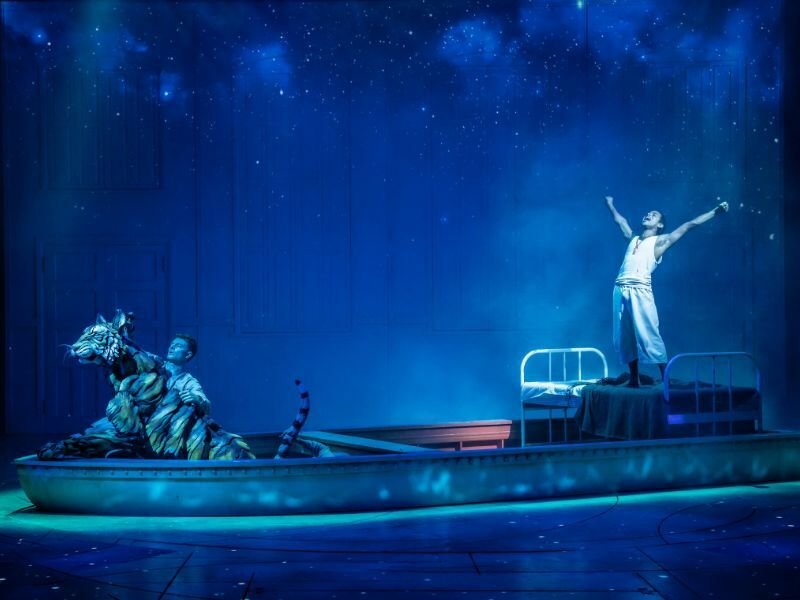
The ocean, an immense canvas mirroring the sky, cradles a lone lifeboat, a desperate young man, and a Bengal tiger. This iconic image from Ang Lee's Life of Pi isn't just a stunning visual; it's the culmination of intricate decisions, meticulous planning, and an unwavering artistic vision. Delving into the production of Life of Pi, particularly its casting choices and director's vision, reveals a masterclass in adaptation—one that, remarkably, we can now dissect and even simulate with the precision of AI.
This isn't merely a retrospective; it's an exploration of how a seemingly "unfilmable" novel found its breathtaking cinematic form, and how the cutting edge of AI-driven cinematic analysis offers us unprecedented insights into its creation, transforming how we understand and even craft future blockbusters.
At a Glance: Peeking Behind the Pi Curtain
- Ang Lee's Audacious Vision: How the director navigated the "unfilmable" novel, prioritizing emotional truth and philosophical depth over literal adaptation.
- The Quest for Pi: The rigorous, global casting search that led to newcomer Suraj Sharma, emphasizing authenticity over celebrity.
- Digital Alchemy: How groundbreaking visual effects brought Richard Parker to life, making the impossible believable.
- AI's New Lens: Discover how advanced platforms like ReelMind.ai can analyze Ang Lee's distinct cinematic style, from color palettes to narrative arcs.
- Virtual Director, Real Insights: Learn about AI Agent Nolan, which provides data-driven recommendations for scene composition and storytelling, echoing a director's thought process.
- Future of Filmmaking: Understand how AI is democratizing directorial expertise, enabling radical experimentation, and enhancing visual fidelity in film production.
The Unseen Symphony: Ang Lee's Vision for Life of Pi
Adapting Yann Martel's Life of Pi was considered a cinematic Everest. Its core premise—a boy, a tiger, and a tiny boat—is deceptively simple, yet the novel's philosophical depth, magical realism, and internal monologue presented formidable challenges. Many directors tried, many failed to find the right entry point. But Ang Lee, a filmmaker celebrated for his genre-fluidity and profound humanism (from Sense and Sensibility to Crouching Tiger, Hidden Dragon to Brokeback Mountain), saw not just a story of survival, but a fable about faith, storytelling, and the nature of reality itself.
Lee's vision was clear from the outset: to immerse the audience in Pi's subjective experience, using groundbreaking visual effects not as spectacle for its own sake, but as a direct conduit to Pi's mind and soul. He understood that the film needed to be as visually stunning as it was emotionally resonant, bridging the gap between the fantastic and the deeply human. This meant an unflinching commitment to capturing the ocean's terrifying beauty, the tiger's raw power, and the boy's spiritual awakening. It was an ambition that demanded meticulous planning, an almost spiritual dedication, and, crucially, the perfect Pi.
Finding Pi: The Quest for an Authentic Core
The success of Life of Pi hinged almost entirely on the believability of its central character, Pi Patel. He had to carry the entire film, often alone on screen, conveying terror, wonder, despair, and an unshakeable will to live, all while interacting with an animal that was, for the most part, a digital creation. Ang Lee wasn't looking for a star; he was looking for Pi.
The casting search was exhaustive, spanning across India and beyond, interviewing thousands of young men. Lee sought innocence, resilience, an innate intelligence, and a capacity for deep emotional expression. He famously cast Suraj Sharma, a then-unknown 17-year-old high school student who accompanied his brother to the audition. Sharma had no acting experience, but Lee saw in him the very essence of Pi: a certain purity, eyes that could convey immense feeling, and an almost preternatural connection to the character's journey. Sharma's raw authenticity was invaluable, allowing audiences to truly invest in his harrowing ordeal.
This choice underscored Lee's directorial philosophy: authenticity over manufactured star power. Other key casting decisions, like Irrfan Khan as the older Pi and Tabu as Pi's mother, brought gravitas and subtle emotional layers to their roles, grounding the fantastical journey in poignant human relationships. Even initial casting considerations, such as the potential involvement of actors like Gerard Depardieu, reflect the careful thought given to each character's contribution to the narrative tapestry. You might find it interesting to consider Depardieu's perspective on Life of Pi and how such a robust personality might have shaped an early iteration of the project. Ultimately, Lee prioritized the integrity of the story, making choices that served the vision first and foremost.
Beyond the Frame: Decoding Directorial Style with AI
For years, analyzing a director's "vision" was a subjective art, relying on critical reviews and film theory. But what if we could quantify it? What if we could break down Ang Lee's distinctive approach to Life of Pi into measurable data points, understanding precisely how his choices in color, lighting, and pacing evoked such powerful emotions? This is where the burgeoning field of AI-driven cinematic vision comparison steps in, offering a scientific lens to appreciate artistic genius.
The global AI in video generation market, projected to reach a staggering $15.5 billion by 2027, is rapidly transforming how we create, analyze, and even replicate directorial styles. This isn't just about making cool videos; it's about unlocking the very DNA of cinematic language.
ReelMind.ai: A New Lens on Filmmaking
Platforms like ReelMind.ai stand at the forefront of this revolution. Imagine having access to over 101 AI models, each trained to understand and generate photorealistic, cinematic-quality video content. For a film like Life of Pi, which relied so heavily on visual fidelity and nuanced emotional expression, these tools offer unparalleled analytical capabilities.
Models like the Flux Series (Pro, Dev, Schnell, Redux) provide unparalleled quality and prompt understanding, crucial for generating variations of Pi's fantastical journey. Runway Gen-4 and Gen-3 Alpha Turbo ensure consistent characters and objects—a godsend when depicting Pi and Richard Parker across countless scenes. Meanwhile, the OpenAI Sora Series (Turbo, Standard) excels in realism and narrative understanding, perfect for dissecting the core emotional beats of Pi's story directly from text-to-video generation. Specialized tools like PixVerse V4.5, with its 20+ cinematic lens controls, could even simulate the specific aesthetic choices Ang Lee made for different scenes, such as the wide, sweeping shots of the ocean or the intimate close-ups of Pi's face.
The AI Toolkit: Deconstructing Life of Pi's Visual & Narrative DNA
How exactly can AI unravel the magic behind Life of Pi? By dissecting it into quantifiable elements:
- Visual Dissection: AI can meticulously analyze the color palettes of Life of Pi—from the vibrant, saturated hues of India to the serene blues of the calm ocean, and the ominous grays of a storm. It breaks down lighting techniques, distinguishing between natural sunlight, the ethereal glow of bioluminescent plankton, and the harsh artificiality of the freighter. Camera movements, pacing (the meditative slowness of Pi drifting, contrasted with the frantic cuts during the storm), scene duration, and even the subtle use of split-screen effects can all be quantified and mapped. This allows us to see patterns in Lee's visual grammar that might otherwise remain subconscious.
- Narrative Analysis: Using natural language processing (NLP) and temporal analysis, AI can map out Pi's narrative arc. It can identify key plot points—the sinking of the Tsimtsum, the discovery of Richard Parker, the storm, the floating island—and quantify the build-up of tension, the progression of character development (Pi's transformation from a curious boy to a hardened survivor), and the overarching thematic progression of faith, doubt, and the power of storytelling.
- Style Transfer: Imagine taking the distinctive visual filters or atmospheric effects from Ang Lee's Life of Pi—say, the dreamy, almost painterly quality of the sunset scenes—and applying them to entirely new footage. AI can isolate these unique aesthetic signatures and transfer them, allowing filmmakers to experiment with Lee's "look" in novel contexts or to understand its components more deeply.
- Simulation: AI allows creators to generate variations of scenes by altering parameters. What if the depth of field were shallower in a close-up of Pi's face, or the lighting intensity slightly different during a confrontation with Richard Parker? AI can simulate these changes, providing data-driven insights into how each adjustment impacts the emotional resonance and perceived meaning of the scene. This can help future directors make more informed choices.
- Bridging Styles: AI can identify commonalities or contrasts between disparate directorial styles. You could compare Ang Lee's meticulous, emotionally driven approach in Life of Pi to, say, Christopher Nolan's non-linear narrative structures, revealing fascinating insights into how different masters craft their cinematic worlds. This capability fosters cross-pollination, leading to new hybrid aesthetics.
Agent Nolan: Your Virtual Director's Chair
Beyond analysis, AI is moving into creation. ReelMind.ai's flagship AI Agent Director, Nolan, acts as a virtual director, embodying a vast knowledge base of cinematic techniques. For a director like Ang Lee, Nolan could have provided intelligent scene composition suggestions, drawing from data on optimal framing for emotional impact. It could offer guidance on narrative structure, analyzing the pacing of the original novel and suggesting cinematic rhythms that best translate its philosophical themes.
Imagine a scenario where a human director like Lee provides the overarching artistic vision and emotional resonance, while Nolan offers data-driven insights to elevate artistic quality and technical execution. For Life of Pi, Nolan could have analyzed the hundreds of hours of raw footage, identifying optimal takes for specific emotional beats, or suggesting subtle camera adjustments to enhance Pi's isolation or wonder. It's a powerful collaboration, where AI augments human creativity rather than replacing it.
The Art of Consistency: Multi-Image Fusion and Character Fidelity
One of the most remarkable technical achievements in Life of Pi was the seamless integration of the CGI Richard Parker with live-action elements. Maintaining visual consistency for a complex character like a tiger, whose appearance, movements, and emotional states needed to be believable across countless shots, was a monumental task.
ReelMind.ai's multi-image fusion feature directly addresses this challenge. By training AI models with multiple reference images, it ensures consistent character keyframes across various scenes, styles, and themes. For Life of Pi, this would translate to:
- Consistent Tiger Portrayal: Richard Parker's fur texture, muscle definition, and facial expressions would remain perfectly consistent, whether he's drenched in a storm, stalking Pi in a calm sea, or appearing as a subtle reflection in the water.
- Pi's Transformation: As Pi endures months at sea, his physical appearance changes. Multi-image fusion could ensure that these subtle shifts—the weight loss, the tanned skin, the growing hair—are meticulously tracked and applied consistently across the character's long journey, maintaining visual fidelity.
- Emotional Nuance: The AI could be trained on reference images of various emotional states for Pi, ensuring that his subtle facial cues of fear, hope, or despair remain consistent and believable throughout the narrative, regardless of the scene's visual context.
This capability is not just about technical perfection; it's about preserving the emotional integrity of the story, ensuring that the audience's immersion is never broken by an inconsistent visual.
AI's Transformative Impact on Cinematic Storytelling
The implications of AI for filmmaking, particularly through platforms like ReelMind.ai, are far-reaching and profoundly exciting:
- Unprecedented Analytical Depth: We can dissect cinematic language with a level of detail never before possible, understanding the "why" behind successful artistic choices.
- Democratization of Directorial Expertise: Sophisticated techniques, once the domain of seasoned professionals, become accessible to emerging creators. AI acts as a mentor, guiding users toward more effective storytelling.
- Radical Experimentation: Creators can blend and innovate on established styles, perhaps even imagining what Life of Pi might look like directed by a different visionary, or fusing Ang Lee's visual poetry with a contemporary action aesthetic.
- Enhanced Character Consistency and Visual Fidelity: Features like multi-image fusion eliminate continuity errors and ensure that even the most complex digital characters are consistently believable, freeing artists to focus on narrative.
- Fostering a Collaborative Creator Economy: ReelMind.ai encourages users to train and publish their own AI models, earning credits and contributing to a dynamic ecosystem of shared tools and knowledge.
This is not a distant future. AI-generated films are expected to become commonplace within the next two to three years, with AI directors playing an increasingly integral role. The analytical depth provided by AI is making us rethink the very definition of a director's vision, allowing us to reverse-engineer masterpieces like Life of Pi and apply those learnings to new creative endeavors.
Demystifying AI in Filmmaking: Common Questions
As AI becomes more prevalent, it naturally raises questions. Let's tackle a few:
"Will AI replace human directors like Ang Lee?"
Absolutely not. The ideal scenario involves a hybrid approach. AI, through agents like Nolan, provides data-driven insights and generative capabilities, handling technical complexities and offering informed suggestions. The human director, however, remains the source of artistic vision, emotional resonance, intuition, and the unique spark of creativity that AI cannot replicate. AI is a powerful collaborator, not a replacement.
"Is this technology only for big Hollywood studios with huge budgets?"
While large studios will undoubtedly leverage these tools, platforms like ReelMind.ai are designed to democratize access. By offering a credit system and a user-friendly interface, sophisticated AI models and directorial expertise become accessible to independent filmmakers, students, and aspiring creators, leveling the playing field.
"Isn't using AI for creative work just 'cheating'?"
This misconception overlooks the transformative potential of AI as a tool. A painter doesn't "cheat" by using a new type of brush or paint. A musician doesn't "cheat" by using digital instruments. AI empowers creators by automating tedious tasks, providing analytical insights, and enabling experimentation that would otherwise be impossible. It frees up human creativity to focus on the higher-level artistic challenges and storytelling.
Ready to Direct the Future? Navigating AI in Your Creative Process
Understanding the intricate production of a film like Life of Pi—the visionary director, the authentic casting, the groundbreaking effects—gives us a deeper appreciation for the art of filmmaking. Now, with AI, we have tools to not only appreciate but to learn from, deconstruct, and even simulate these creative processes.
If you're looking to harness this power in your own creative endeavors, consider these actionable steps:
- Assessment and Planning: Start by defining your creative goals. What kind of visual or narrative themes are you aiming for? How could a specific element, like Ang Lee's use of color in Life of Pi, inspire your project?
- Tool Selection and Setup: Explore the vast array of models on platforms like ReelMind.ai. Familiarize yourself with its 101+ AI models, understand the credit system, and dive into tutorials and community forums. Find the models that best align with your specific needs, whether it's photorealism, character consistency, or narrative analysis.
- Implementation and Testing: Begin with small, manageable projects. Use Agent Nolan for initial scene concepts or to refine narrative structure. Experiment with different models to generate footage, and critically test features like multi-image fusion to ensure character consistency. Iterate based on your results, learning from each attempt.
- Optimization and Scaling: As your proficiency grows, optimize your workflows. Learn to combine different AI models for synergistic effects. Explore the possibility of training and publishing your own custom models on the platform, potentially monetizing your unique creative insights. From there, you can scale your projects, tackling increasingly ambitious creative challenges with the powerful assistance of AI.
The cinematic landscape is evolving rapidly, driven by robust technical architectures like ReelMind.ai's NestJS, TypeScript, PostgreSQL, and Cloudflare foundation. Embrace AI not as a competitor, but as a powerful collaborator, a sophisticated assistant that can illuminate the genius of past productions like Life of Pi and empower you to craft the unforgettable stories of tomorrow. The future of filmmaking is here, and it's a future where human vision and artificial intelligence dance in perfect, creative harmony.